
SIEM provides visibility and context so your team can detect suspicious activity; SOAR automates and orchestrates what happens after an alert fires. If your security operations centre struggles to see what is happening across the network, SIEM is the priority. If your team sees threats but responds too slowly or inconsistently, SOAR closes that gap. The two technologies work best together, not as alternatives.
TL;DR:
- Organizations should focus on SIEM first if they lack visibility across their environment, as effective detection is its primary function.
- SIEM data must be carefully targeted, prioritizing logs from authentication, firewalls, DNS, hosts, and cloud sources to avoid noise without improving detection.
- SOAR is most valuable when there are high volumes of repetitive alerts, well-understood remediation steps, and a need for coordinated responses across multiple tools.
- Integration of SIEM and SOAR creates a pipeline where alerts are enriched and automated actions executed, but governance and proper testing are critical to prevent errors.
- Conducting a threat-led log gap assessment helps determine whether the current issue is inadequate monitoring or slow response, guiding subsequent platform investments.
Table of Contents
- What is SIEM and how does it support detection?
- What is SOAR and how does it automate response?
- Key differences that matter to decision-makers
- How SIEM and SOAR integrate in practice
- How to choose and implement: a practical roadmap
- How LANCAST supports SIEM and SOAR outcomes
- A straightforward next step for most teams
- Ready to close your SIEM and SOAR gaps?
- Sources
- FAQ
What is SIEM and how does it support detection?
Security Information and Event Management platforms collect, normalise and correlate security events from across an organisation’s systems, then alert analysts to activity that looks suspicious. The NCSC describes SIEM-style detection as enabling near-real-time searches across log sources, alongside historical analysis that supports investigation long after an event occurs.
A SIEM is only as useful as the data feeding it. NCSC onboarding guidance recommends starting with threat modelling rather than ingesting every available log source, since unfocused onboarding creates noise without improving detection. Certain categories consistently deliver the most value:
- Authentication logs, which reveal credential misuse and account compromise.
- Security control logs from firewalls, endpoint protection and proxies.
- DNS queries, which often expose command-and-control activity early.
- Host and network telemetry that shows lateral movement.
- Cloud platform logs, increasingly central as infrastructure shifts off-premises.
Tuning is ongoing work rather than a one-off project. Analysts need to manage false positives, retire stale detection rules and build new use cases as the threat picture changes. SIEM can be deployed on-premises, as a cloud-native platform, or through a managed SIEM service where a provider handles much of the tuning burden, such as with JETi Consulting’s SentinelX intelligent monitoring.
Pro Tip: Start with the “must-have” log categories NCSC identifies before expanding coverage. Broad ingestion without a threat-led plan slows detection rather than improving it.
What is SOAR and how does it automate response?
Security Orchestration, Automation and Response platforms take the alerts a SIEM generates and act on them. A SOAR platform typically combines orchestration connectors to other security tools, automation steps that execute without manual intervention, case management to track investigations, and playbooks that define how a given alert type should be handled.
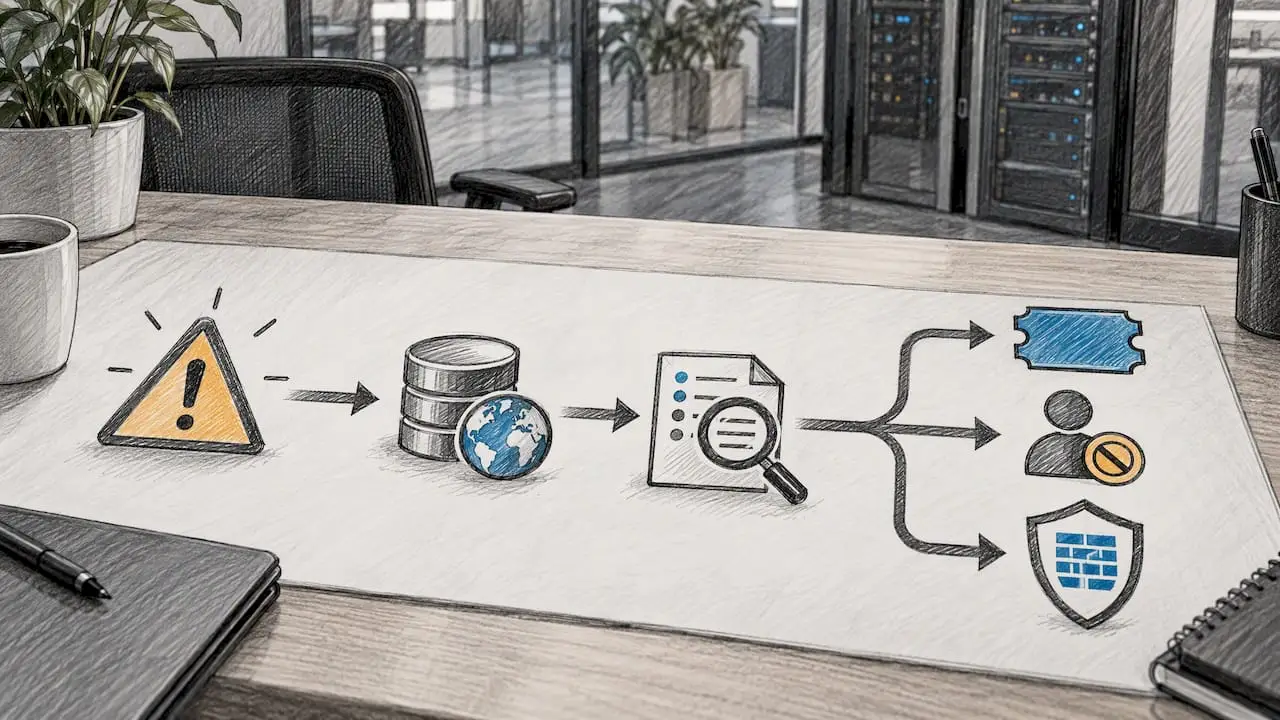
SOAR’s main value is enrichment and speed. When an alert fires, a playbook can automatically pull threat intelligence, gather contextual evidence from other systems and present an analyst with a far richer picture than the raw alert alone. From there, many organisations automate routine actions: opening a ticket, suspending a compromised account, or blocking a malicious IP address.
Governance matters as much as the automation itself. Not every action should run unattended. Feed confidence and indicator expiry need regular review, since acting on stale threat intelligence can cause more harm than the alert it was meant to resolve. Some decisions, particularly ones with business impact, are better left to an analyst.
SOAR tends to earn its keep fastest in specific conditions:
- High volumes of repetitive, low-complexity alerts that drain analyst time.
- Remediation steps that are genuinely repeatable and well understood.
- Incidents that require coordinated action across several disconnected tools.
Pro Tip: Automate the steps your analysts already do the same way every time. Reserve judgement calls for humans until the playbook has a proven track record.
Key differences that matter to decision-makers
The clearest way to separate the two is by what each is built to do. SIEM exists to detect and contextualise; SOAR exists to act on what has already been detected. That single distinction shapes almost every other difference between them.
Data handling diverges too. SIEM platforms are built around long-term log storage, correlation across sources and historical search, which carries direct compliance weight. The ICO’s guidance on data security notes that without appropriate logs, an organisation may struggle to establish what happened during an incident or assess exfiltration risk, which complicates breach reporting obligations. SOAR, by contrast, focuses on case records and action history rather than raw log retention.
Analyst workflows differ in a similar way. SIEM work is largely investigative: reviewing alerts, searching historical data and deciding whether something constitutes an incident. SOAR work is procedural: building, testing and maintaining playbooks, and deciding which actions are safe to automate.
Operational cost follows the same split. SIEM maintenance is mostly tuning, detection content and false-positive management. SOAR maintenance is playbook engineering, including version control and testing before any automated action goes live.
Useful KPIs differ accordingly:
- Time to detect and mean time to identify (MTTI), which measure SIEM effectiveness.
- Mean time to detect (MTTD) across the full alert pipeline.
- Time to contain, which reflects how quickly SOAR-driven actions reduce exposure.
- Automation success rate, tracking how often automated playbooks resolve incidents without manual rework.
Gartner’s SIEM glossary frames this same split at a vendor level: SIEM supports detection and investigation through real-time and historical analysis, while SOAR is defined around orchestration and automation of the response that follows.
How SIEM and SOAR integrate in practice
In a mature SOC, the two platforms work as a single pipeline rather than separate tools. Logs are ingested into the SIEM, correlated, and turned into alerts. Those alerts pass to SOAR, which enriches them with threat intelligence and contextual evidence, then triggers a playbook. Depending on confidence and severity, the playbook either escalates to an analyst or executes predefined actions.
Typical automated actions include:
- Creating a ticket in the case management system automatically.
- Blocking a malicious IP address at the firewall or proxy.
- Suspending a compromised user account pending investigation.
- Pulling additional context from threat intelligence feeds before an analyst even opens the case.
NCSC’s SOC operating model guidance separates detection, investigation, incident response and incident management as distinct functions, with runbooks and playbooks supporting the handover between them. ENISA frames incident handling as a lifecycle spanning detection, triage, resolution, closure and post-analysis, treating automation as a way to increase capacity rather than a replacement for human judgement and ownership.
This integration has real failure modes. Stale indicators can trigger unnecessary containment actions. Insufficient context can lead a playbook to act on an incomplete picture. Poorly governed automation can run further than intended, blocking legitimate users or disrupting business systems. Version control, test cases and rollback criteria for every playbook mitigate most of this risk.
For organisations without the resource to build and maintain both capabilities internally, a managed SOC or MSSP model is often the fastest way to get combined detection and response working reliably.
How to choose and implement: a practical roadmap
The decision rule is straightforward: if you lack visibility into what is happening across your environment, prioritise SIEM. If you can already see threats but your response is slow, manual or inconsistent, prioritise SOAR. Most organisations eventually need both, but the order depends on where the current gap actually sits.
A focused pilot keeps the project manageable:
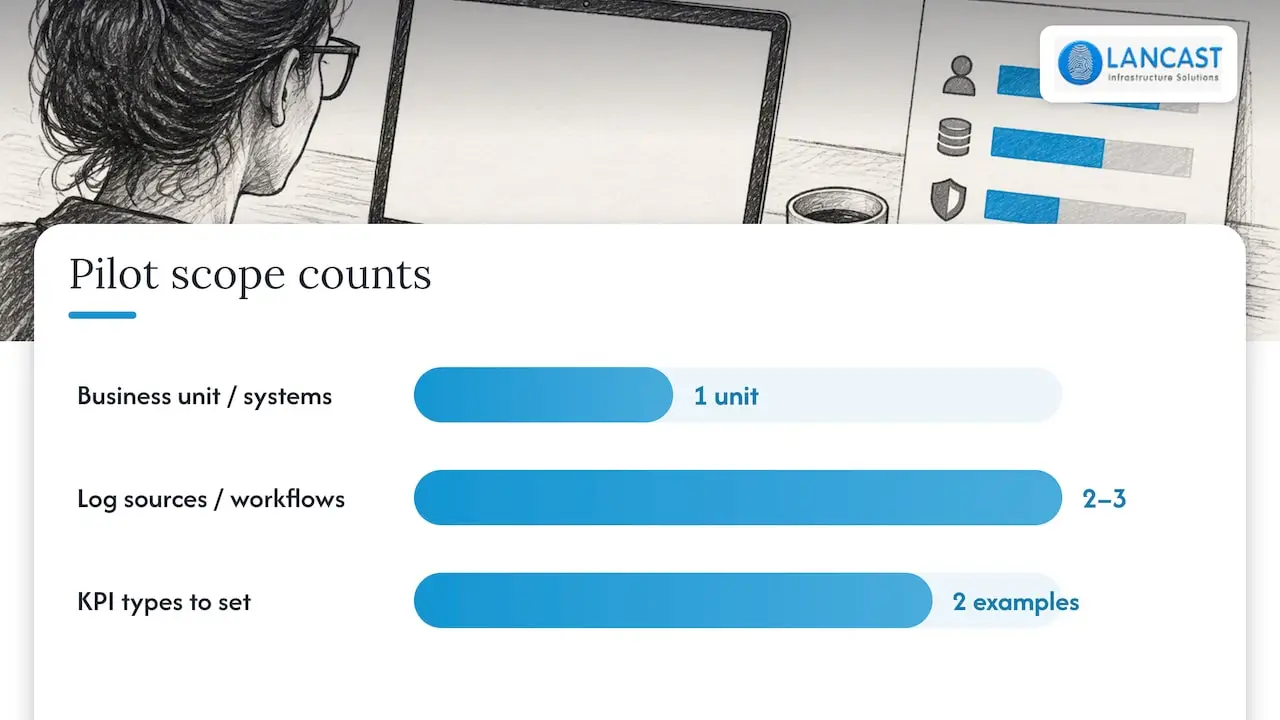
- Define scope narrowly, covering one business unit or a small set of systems rather than the whole estate.
- Choose two to three high-value log sources or workflows, such as authentication logs or a single repeatable response action.
- Set measurable KPIs before starting, including time-to-detect or automation success rate, so the pilot has a clear pass or fail line.
- Agree rollback criteria in advance, so a playbook or detection rule that misfires can be withdrawn quickly.
Implementation itself tends to follow a consistent sequence: threat modelling to identify what matters most, log onboarding guided by that modelling, detection content development, playbook creation for the response side, and runbook testing before anything goes live. NCSC’s SOC guidance is explicit that technology choices should follow a threat-informed operating model, not the other way round.
Staffing and governance decide whether any of this holds up over time. Someone needs clear ownership of detection content and someone needs clear ownership of playbooks, with a defined cadence for reviewing both as the threat picture shifts. Treat this as continuous improvement rather than a project with an end date.
Pro Tip: Run the pilot with a hard KPI and a hard deadline. A pilot without a defined success threshold tends to drift indefinitely without ever reaching production.
How LANCAST supports SIEM and SOAR outcomes
LANCAST’s managed services include continuous monitoring, vulnerability management and threat risk assessment, the groundwork most organisations need before detection or automation projects succeed. As an HP Amplify Partner and Microsoft Cloud Service Provider, LANCAST brings 30 years of IT infrastructure experience to log onboarding, tuning and playbook development, work that typically slows internal teams without dedicated SOC resource.
A straightforward next step for most teams
Start with a threat-led log gap assessment before buying any platform. It is the cheapest way to find out whether your real problem is visibility or response speed.
— Carl
Ready to close your SIEM and SOAR gaps?
Most organisations do not need to choose between buying a SIEM, buying a SOAR, or hiring more analysts. LANCAST scopes an initial gap analysis against your current logging and response workflows, then designs a pilot around the highest-value sources or actions we find, with ongoing managed services available once the pilot proves out.

A typical engagement includes:
- An initial scoping call to identify your current visibility and response gaps.
- A short gap analysis against NCSC-aligned detection and response practices.
- A pilot design with agreed KPIs before any wider rollout.
- Ongoing managed monitoring and support once the approach is proven.
Request an initial review through our security and vulnerability management page to see where your current setup stands.
Sources
- NCSC — Building a security operations centre: detection approaches
- ICO — A guide to data security: ransomware and data protection compliance
- Gartner — SIEM glossary
FAQ
What is the main difference between SIEM and SOAR?
SIEM collects and correlates security events to detect suspicious activity and support investigation, while SOAR automates and orchestrates the response once an alert exists. The NCSC frames this as detection versus orchestrated action, and most mature SOCs run both together rather than choosing one.
Is Splunk a SIEM or a SOAR?
Splunk’s core platform is a SIEM, built around log collection, correlation and alerting, though Splunk also offers a separate SOAR product for orchestration and automation. The two serve different functions even when sold by the same vendor.
Is Microsoft Sentinel a SIEM or SOAR?
Microsoft Sentinel is primarily a cloud-native SIEM, handling log collection, correlation and detection, with built-in automation features that extend into SOAR-style orchestration. It sits closer to the SIEM category by original design, with automation layered on top.
What is replacing SIEM?
Nothing is formally replacing SIEM; detection and correlation remain a core SOC function regardless of platform. What is changing is how SIEM is delivered, with more organisations choosing cloud-native or managed SIEM services rather than running the platform entirely in-house.
Should a small organisation start with SIEM or SOAR?
Most smaller organisations should start with SIEM, since without reliable visibility there is little for SOAR to act on. Once detection coverage is solid, automating the most repetitive response tasks delivers the next clear return.