
Continuous security monitoring is the ongoing, near real time collection and analysis of telemetry that lets an organisation detect and respond to attacks faster, measured as shorter time to detect and time to respond. It draws on logs, endpoint activity, network flows and threat intelligence feeds to build a live picture of what is happening across an estate. Done well, it shifts a security function from reacting to incidents after the damage is done to catching them while they are still containable.
TL;DR:
- Focusing on high-value assets and critical systems helps reduce noise and cost while improving detection and response times more effectively.
- Automated tuning, regular rule review, and validation with realistic exercises are essential for maintaining detection accuracy and avoiding alert fatigue.
- Metrics like time to detect and respond are the only reliable indicators of a continuous monitoring program’s success, not ticket volume or raw log data.
- Cost-effective strategies involve combining endpoint, network, DNS, and cloud monitoring, prioritizing risk over ease of deployment.
- Partnering with managed security services often provides the expertise and tools needed for effective continuous monitoring without overstretching internal teams.
Table of Contents
- What continuous security monitoring actually means
- Why continuous security monitoring matters for your organisation
- How the monitoring pipeline fits together
- Building a continuous monitoring programme step by step
- Measuring effectiveness: the metrics that matter
- How a managed security monitoring service fits into the picture
- Common pitfalls and keeping the programme healthy
- Connecting monitoring to incident response and remediation
- Compliance and regulatory considerations
- Automation and orchestration in a monitoring programme
- Where machine learning and AI genuinely help
- Scaling continuous monitoring across large or cloud environments
- What successful implementations tend to have in common
- An honest take on what continuous monitoring actually requires
- How we support continuous monitoring at LANCAST
- FAQ
- Sources
What continuous security monitoring actually means
The term gets used loosely, so it helps to anchor it in how standards bodies define it. NIST describes information security continuous monitoring, or ISCM, as maintaining ongoing awareness of information security, vulnerabilities and threats to support organisational risk decisions. The emphasis sits on awareness and decision support, not simply on switching on more logging.
‘Continuous’ does not mean every system is watched every millisecond with equal intensity. In practice it means near real time collection on a risk based cadence: critical systems get tighter monitoring windows and faster alerting, while lower risk assets might be reviewed on a longer cycle. The National Cyber Security Centre frames this as designing a security operations model around the organisation’s own assets, threats and resources rather than chasing a feature list.
Scope matters as much as cadence. A mature programme watches controls (are protections actually working), assets (what exists and who owns it), vulnerabilities (what is exposed) and threats (what is actively trying to get in). Missing any one of these leaves a blind spot that attackers tend to find before defenders do.
Why continuous security monitoring matters for your organisation
The core payoff is speed. Shorter detection and response times reduce the window an attacker has to move laterally, exfiltrate data or deploy ransomware, and the NCSC treats time to detect and time to respond as the only metrics that genuinely reflect whether a security operations function is working.
Beyond speed, continuous monitoring builds forensic readiness. When an incident does happen, investigators need a reliable record of what occurred, when, and in what order. A programme that already captures the right telemetry, with consistent timestamps, turns a chaotic post breach scramble into a structured investigation. That same record supports compliance evidence, since many regulatory frameworks expect organisations to demonstrate ongoing oversight rather than a point in time audit.
None of this is free. Continuous monitoring carries real trade-offs: tooling and storage costs scale with log volume, skilled analysts are in short supply, and a programme that is switched on but never tuned generates noise rather than insight. Organisations that weigh these costs honestly, rather than assuming more logging always equals more security, tend to build programmes that last.
How the monitoring pipeline fits together
A continuous monitoring architecture is a pipeline, and each stage has a job. Collection agents and log forwarders gather telemetry from endpoints, network devices, cloud platforms and identity systems. That data moves over secure transport, typically TLS, into a central platform, usually a SIEM or log analytics tool, where it is normalised into a consistent format so that an authentication event from one system can be compared with one from another.

Once normalised, data is stored for both active analysis and longer term retention, then run through correlation rules and enrichment, which adds context such as asset ownership or threat intelligence matches. Correlation is what turns a single failed login into a meaningful alert when it is tied to ten other failed logins across different accounts in the same minute. Without it, analysts drown in isolated events that mean nothing on their own.
Automation earns its place at the alerting and triage stage: suppressing known false positives, enriching alerts automatically and routing the highest confidence ones to analysts first. It is poorly suited to the judgement calls that follow, deciding whether an unusual pattern is a genuine threat or a quirky but legitimate business process still needs a trained analyst.
Data integrity underpins all of it. NCSC guidance for network device producers recommends ISO 8601 timestamps in UTC, synchronised through monitored NTP sources, with near real time log transfer so that records cannot be quietly altered after the fact. A timeline built from inconsistent clocks is next to useless in an investigation, so getting this detail right early saves considerable pain later.
Building a continuous monitoring programme step by step
A programme stands a far better chance of working when it is designed deliberately rather than assembled tool by tool. The following sequence reflects how mature security operations functions tend to build theirs:
- Define the outcomes you need and map them to business risk: what would a serious incident cost, and which assets would be involved.
- Design a target operating model proportionate to that risk, following the NCSC’s advice to shape the model around your own organisation rather than copying someone else’s.
- Pilot log collection on a small set of high value assets before onboarding the wider estate.
- Author detection content for the threats most relevant to your sector, using a framework like MITRE ATT&CK to check coverage against known adversary techniques.
- Schedule recurring threat hunting and detection rule review rather than leaving rules static once deployed.
- Maintain a log source roadmap and revisit it every six to twelve months as the estate changes.
Pro Tip: Start with the assets that would hurt most if compromised, not the ones that are easiest to connect to your SIEM.
Tuning deserves particular attention in the early months. A new detection rule almost always generates false positives at first, and resisting the urge to disable it rather than refine its thresholds is often what separates a programme that matures from one that gets switched off in frustration. Mapping detection coverage against MITRE ATT&CK also helps teams see where they are blind, rather than assuming broad log collection equals broad detection.
Measuring effectiveness: the metrics that matter
Time to detect and time to respond are the two figures that actually tell you whether continuous monitoring is working. The NCSC states plainly that these are the only external metrics that genuinely reflect a security operations function’s efficacy, treating everything else, including ticket volumes, as internal health indicators at best.
Ticket counts and raw log volume are tempting because they are easy to report, but they reward the wrong behaviour. A team can close large numbers of tickets or ingest huge volumes of data without getting any faster at catching a real attacker, and chasing those numbers can even encourage analysts to close investigations prematurely.
Validation closes the gap between assumed and actual coverage. Red or purple team exercises, atomic tests mapped to specific MITRE ATT&CK techniques, and hypothesis led threat hunts all test whether detection content fires when it should, rather than simply existing on paper. When reporting metrics upward, frame them around detection and response speed, and be explicit that volume based figures describe workload, not effectiveness.
How a managed security monitoring service fits into the picture
Running continuous monitoring well requires staff available around the clock, tooling that is kept current, and the discipline to tune detection content as threats change, which is why many organisations rely on managed IT and cybersecurity services to maintain robust protection. That combination is hard to build internally when a team is already stretched across day to day IT support, which is why many organisations bring in a managed partner for this specific function.
We manage security and vulnerability services including penetration testing, vulnerability management and threat risk assessment, built on the same principle underpinning continuous monitoring: finding and addressing exposure before it becomes an incident. As an HP Amplify Partner and Microsoft Cloud Service Provider, we bring vendor relationships and proactive managed services into how we support a client’s estate.
Onboarding typically follows a similar shape to the programme steps above:
- Inventory the assets and log sources already available.
- Onboard the highest priority sources first, then expand coverage.
- Tune detection content against real traffic rather than leaving defaults in place.
- Report on detection and response times, not ticket volumes, so clients see genuine progress.
In house teams with the staff and budget to run this around the clock may reasonably keep it internal. Teams without that capacity gain more from a partner who already carries the tooling and the on-call rota.
Common pitfalls and keeping the programme healthy
The most common mistake is over logging without a plan: switching everything on generates cost and noise without improving detection. The NCSC’s guidance on logging recommends an outcome driven approach instead, choosing what to log based on what an investigation would actually need, rather than defaulting to capturing everything.
Retention windows follow the same logic. The same NCSC guidance suggests a minimum of around six months for many logs, extending to as much as thirteen months for critical services depending on risk and available resources. Investigations into slow moving attacks often need that longer window, since the earliest signs of compromise can predate the point an organisation notices anything wrong.
Automation needs governance too. Rules that suppress or auto close alerts without review can quietly hide genuine incidents, so detection content and automated responses both deserve a recurring review cadence, not a one-off setup. Revisiting rules, thresholds and suppression logic on a regular schedule keeps the programme aligned with how the threat landscape and the estate itself have changed.
Connecting monitoring to incident response and remediation
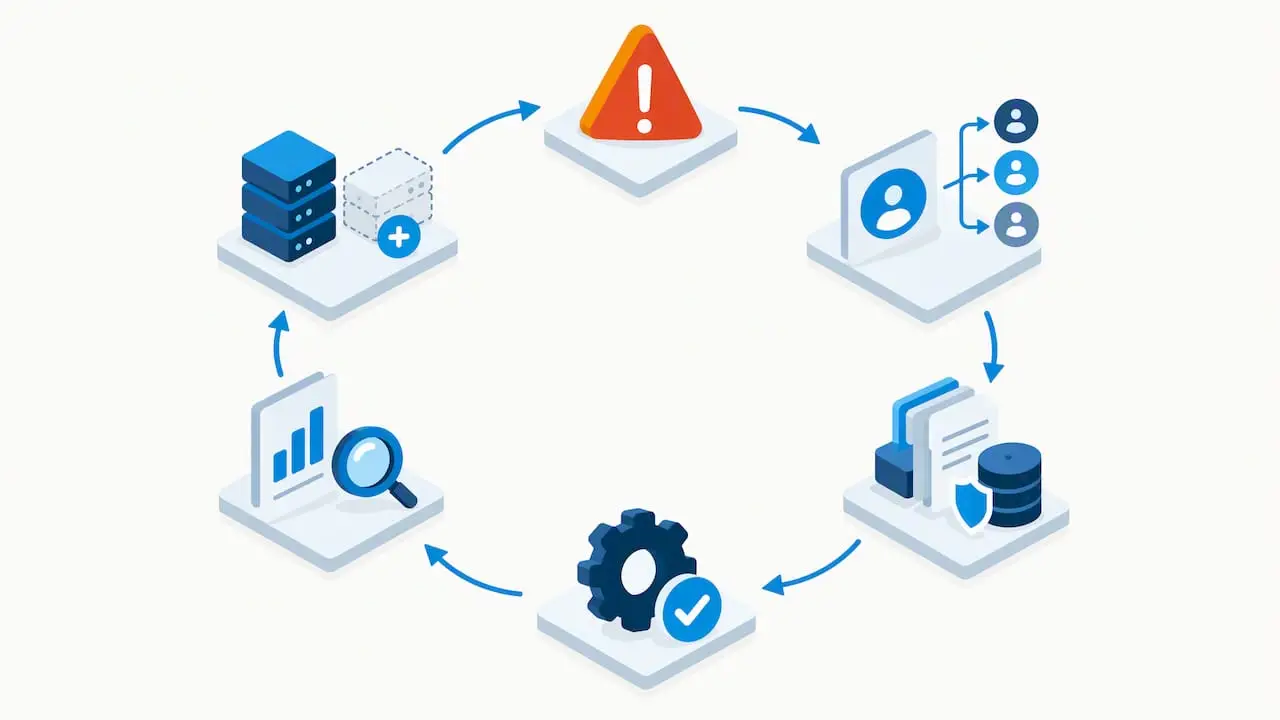
Continuous monitoring only delivers value when its alerts feed directly into a working incident response process. An alert that sits in a queue without a clear owner or escalation path defeats the purpose of detecting the issue quickly in the first place.
The handoff works best when it is defined in advance: which alert severities trigger immediate escalation, who has authority to isolate a host or disable an account, and what evidence needs preserving before remediation begins. Forensic readiness, the timestamped, consistent logging discussed earlier, pays off directly here, since responders rely on that record to understand scope and root cause rather than reconstructing events from memory.
Remediation itself should close the loop back into monitoring. If an investigation reveals a gap, a log source that was missing, a detection rule that should have fired but did not, that gap becomes an input to the next review cycle rather than a one-off fix. Treating each incident as a source of new detection content is how a monitoring programme gets measurably better over time rather than staying static.
Backup and recovery capability also matters at this stage, since containment sometimes means restoring systems from a known good state rather than attempting to clean an active compromise. Having tested backup and disaster recovery arrangements in place means remediation options are not limited to hoping a compromised system can be fully cleaned.
Compliance and regulatory considerations
Continuous monitoring increasingly features as an expectation rather than an option across data protection and sector specific regulation. Organisations handling personal data need to demonstrate ongoing oversight of how that data is accessed and protected, and a continuous monitoring programme is one of the clearest ways to produce that evidence, since it generates a running record rather than a single annual snapshot.
Regulators and auditors tend to favour exactly the kind of outcome driven logging the NCSC recommends: evidence that an organisation can show what happened, when, and how it responded, rather than evidence that every possible event was logged somewhere. That distinction is worth raising with auditors directly, since a programme built around investigation readiness often satisfies compliance requirements more convincingly than one built purely around log volume.
Sector specific obligations vary, and organisations operating across financial services, healthcare or critical infrastructure should check their own regulator’s specific expectations rather than assuming a generic monitoring setup covers every requirement. Where obligations are unclear, treating ISCM’s core aim, maintaining ongoing awareness to support risk decisions, as the baseline keeps a programme defensible even as specific rules change around it.
Automation and orchestration in a monitoring programme
Automation and orchestration tools sit between collection and response, handling the repetitive work that would otherwise consume analyst time. Security orchestration platforms can automatically enrich an alert with asset ownership and threat intelligence context, suppress known benign patterns, and route high confidence alerts to the right analyst without manual triage.
The value of automation is proportional to how well it is scoped. Automating the enrichment and routing of alerts tends to free analysts for genuine investigation work. Automating the response itself, isolating a host or disabling an account without human confirmation, carries more risk and is usually reserved for the highest confidence, lowest ambiguity scenarios, since an automated response to a false positive can cause its own disruption.
Orchestration also plays a role in keeping detection content current, by automatically flagging rules that have not fired in months or that generate disproportionate noise relative to genuine findings. Used this way, automation supports the tuning discipline described earlier rather than replacing the judgement that tuning requires.
Where machine learning and AI genuinely help
Machine learning adds the most value in continuous monitoring where patterns are too subtle or too voluminous for static rules to catch, such as identifying unusual account behaviour across thousands of users or flagging network traffic that deviates from an established baseline. This kind of anomaly detection can surface activity that would not trip any single predefined rule.
The honest limitation is that machine learning models need good training data and ongoing supervision to stay useful, and a poorly tuned model produces its own flood of false positives, just a different flavour from badly written static rules. Treating AI driven detection as one more input that still needs human review, rather than as a replacement for analyst judgement, keeps expectations realistic.
Where it earns its place is in triage: helping prioritise which of the day’s alerts deserve attention first, based on patterns learned from past investigations. That prioritisation role tends to deliver more consistent value than any claim that machine learning alone can replace a skilled analyst’s judgement on a genuinely ambiguous case.
Scaling continuous monitoring across large or cloud environments
Scale changes the nature of the problem. A single data centre with a few hundred endpoints is a manageable logging challenge; a hybrid estate spanning multiple cloud providers, SaaS applications and a distributed workforce generates telemetry volumes and variety that strain both tooling and budget.
Cloud environments add a specific wrinkle: much of the relevant telemetry, identity events, configuration changes, API calls, lives inside the cloud provider’s own logging systems, and pulling it into a central monitoring platform consistently across providers takes deliberate integration work rather than a single agent deployment. Multi-cloud organisations often find that identity and access logs become the highest priority source precisely because credential misuse is the most common route into cloud hosted systems.
Storage cost scales with volume in a way that punishes an unfocused logging strategy, which is why the outcome driven approach to logging discussed earlier matters even more as an estate grows. Large organisations that scale successfully tend to do so by extending a risk based prioritisation model consistently as new systems are added, rather than by trying to apply uniform, maximal logging across an estate that keeps expanding.
What successful implementations tend to have in common
Across the published guidance from bodies such as the NCSC and ENISA, a consistent pattern emerges in organisations that get continuous monitoring right: they start narrow, prove value on a small set of critical assets, and expand deliberately rather than attempting full estate coverage on day one.
That pattern holds regardless of sector. A programme that begins with endpoint telemetry and DNS logging on its most sensitive systems, demonstrates a measurable improvement in detection time, and then extends coverage outward tends to retain organisational support for the investment. A programme that tries to monitor everything at once, without first establishing what a meaningful alert looks like, more often ends up disabled or ignored within its first year because it generates more noise than insight.
The common thread in the guidance is restraint paired with persistence: choosing coverage deliberately, tuning relentlessly, and reviewing the roadmap on a fixed schedule rather than letting it drift. Organisations that treat continuous monitoring as a programme with a lifecycle, rather than a tool that gets switched on once, are the ones whose detection and response times keep improving year over year.
An honest take on what continuous monitoring actually requires
The received wisdom around continuous monitoring is that more visibility is always better, and that is where most programmes go wrong. I have seen the same pattern across the guidance referenced throughout this piece: organisations that chase comprehensive logging without a clear outcome end up with expensive noise, not security.
The programmes that work start narrow, measure the two metrics that matter, time to detect and time to respond, and expand coverage deliberately. If you are starting from scratch, run a lightweight inventory of what you already log, define what a meaningful alert would look like, and only then decide what to add. If your team cannot sustain that discipline around the clock, a managed partner is often the more realistic route than hiring for a function you cannot yet resource properly.
— Carl
How we support continuous monitoring at LANCAST
We build continuous monitoring into the same proactive approach that runs through our managed services: catching problems before they disrupt your business rather than reacting once they already have. Our security services cover penetration testing, vulnerability management and threat risk assessment and planning, giving you a clear view of where your exposure actually sits before monitoring even begins.

We bring established vendor relationships into how we configure and support client environments, and our support plans scale from day to day technical support through to more comprehensive proactive coverage. For organisations without the internal capacity to run detection and tuning around the clock, this gives you a working monitoring function without building one from scratch.
If you want to talk through what continuous monitoring would look like for your estate, get in touch about our managed services and we will talk you through the options.
FAQ
Which are examples of types of continuous monitoring?
Common types include endpoint monitoring, network flow and intrusion detection, DNS and certificate monitoring, cloud and identity log monitoring, and vulnerability monitoring. Most mature programmes combine several of these rather than relying on a single source, since each one covers a different stage of an attack.
What is DLP and SIEM?
Data loss prevention, or DLP, is a category of tooling focused on stopping sensitive data leaving an organisation without authorisation, typically by inspecting content in transit or at rest. A SIEM, or security information and event management platform, is the central system that collects, normalises and correlates log data from across an estate to support detection and investigation; the two are complementary rather than interchangeable.
What are the 5 C’s in security?
Definitions of the “5 C’s” vary depending on the source and context, and there is no single authoritative version agreed across the industry. A common formulation covers change, compliance, cost, continuity and coverage as areas a security programme needs to manage, but organisations should treat this as a loose mnemonic rather than a formal standard.
What are the best tools for continuous monitoring?
The right toolset depends on your environment and existing infrastructure rather than any single fixed answer, but a typical stack combines a SIEM or log analytics platform, endpoint detection and response software, and network flow monitoring. MITRE ATT&CK is widely used alongside these tools, not as a product itself but as a framework for checking how much of the real world attacker technique landscape your detection content actually covers.
How much does continuous monitoring cost to set up?
Cost varies by estate size, the number of log sources onboarded and whether the work is handled in house or through a managed partner, so there is no fixed industry figure. Our managed services and security plans are quoted on request based on your environment, and you can get in touch for a quote tailored to your organisation.
Sources
Not every log source deserves equal investment. Endpoint and host telemetry is usually the highest value source because it sits closest to where attacks actually execute, capturing process creation, command lines and file activity that network data alone cannot show. Network flows and intrusion detection sit a layer back: flow data is far cheaper to store than full packet capture and gives broad visibility across large environments, while full packet capture is reserved for specific investigations where flow metadata is not enough.
DNS and certificate monitoring are often underused given how little they cost to collect. Most malicious infrastructure still relies on domain resolution, so DNS logs can surface command and control activity early. Cloud, identity and privileged access logs round out the picture, since credential misuse and cloud misconfiguration now account for a growing share of incidents that pure network monitoring would miss.
ENISA’s proactive detection guidance recommends exactly this combination: endpoint monitoring, network flow monitoring, and DNS analysis as core measures, with flow monitoring singled out as a cost effective choice for larger environments.
When deciding where to start, prioritise by risk rather than by what is easiest to switch on:
- information security continuous monitoring (ISCM) – Glossary | NIST