

A data protection impact assessment (DPIA) is a written assessment you complete before you start processing personal data in a way that is likely to put people’s rights and freedoms at high risk. In Ireland the duty comes from Article 35 of the GDPR and from Section 84 of the Data Protection Act 2018. The legal responsibility sits with you as the controller. The strongest DPIAs, however, rest on accurate facts about your systems: where data lives, who can reach it, how it is protected and how it is recovered. That is the part of the assessment where your IT environment decides whether the answers are credible.
This guide is written for owners, IT managers and operations leads at small and medium businesses and start-ups. It explains when a DPIA applies, how to complete one in the order the Data Protection Commission (DPC) sets out, and how to prepare the technical evidence so the document is easy to finish and easy to defend.
TL;DR
- A DPIA is required before processing that is likely to result in a high risk to individuals, especially where new technology is involved.
- The DPC’s guidance lists ten screening criteria, and as a rule of thumb meeting at least two points towards a DPIA.
- The DPC publishes a free Sample DPIA Template with seven steps, to be read together with its Guide to DPIAs.
- If a high residual risk remains after your safeguards, you must consult the DPC before you begin processing.
- Whether or not you do a DPIA, record the reasons for your decision, and keep the assessment under review.
Table of Contents
- What a DPIA is and why it matters
- When you need a DPIA in Ireland
- How to complete a DPIA: the DPC’s steps
- When you must consult the DPC
- Using a DPIA template in Ireland
- What to prepare before you start
- Promo: the technical side of your DPIA
- Our perspective
- FAQ
- Sources
What a DPIA is and why it matters
The DPC describes a DPIA as a process designed to identify risks arising from the processing of personal data and to minimise them as far and as early as possible. It is also a way of showing that you comply with the GDPR, which is the accountability principle in practice.
The benefits the DPC lists are practical ones. A DPIA helps you demonstrate compliance, build public confidence, build data protection into a project by design, and cut the cost and disruption of safeguards by designing them in early rather than bolting them on later. For a growing business the last point is the most useful. Changing how a new system handles data before go-live is far cheaper than changing it once staff and customers depend on it.
The EDPB’s guide for small businesses puts it plainly: a DPIA is a written assessment of a planned processing operation that identifies safeguards to reduce risk and to show compliance.
When you need a DPIA in Ireland
The test is whether the processing is likely to result in a high risk to the rights and freedoms of individuals. New technology raises that likelihood. Section 84 of the 2018 Act and Article 35 of the GDPR both look at the nature, scope, context and purposes of the processing.
The EDPB’s guide for small businesses names three situations where a DPIA is compulsory:
- large-scale processing of sensitive data or data on criminal convictions;
- systematic and extensive automated evaluation or profiling that has legal or similarly significant effects;
- large-scale systematic monitoring of publicly accessible areas.
The DPC’s ten screening criteria
The DPC’s guidance gives ten criteria to screen against: evaluation or scoring, automated decision-making, systematic monitoring, sensitive data, large-scale processing, matching datasets, vulnerable data subjects, new technology, transfers outside the EU, and processing that prevents people from exercising a right or using a service. As a rule of thumb, meeting at least two of them indicates a DPIA is required.
On top of that, the DPC adopted a list under Article 35(4) on 15 November 2018. It names further types of processing that need a DPIA where your screening shows high risk, including systematic monitoring of location or behaviour, large-scale profiling, profiling that decides access to services, combining datasets for profiling, and use of biometric or genetic data alongside other criteria. The full wording is in the DPC’s November 2018 requirements note.
Everyday examples
The examples below are our illustration of how the criteria apply to ordinary business projects, not a list from the DPC.
- A field-service firm rolls out GPS tracking and geofencing on staff phones. That is systematic monitoring of behaviour and location, and it concerns employees, who are often treated as vulnerable data subjects because of the imbalance of power with their employer.
- A clinic or practice moves patient records to a new cloud system. Health data is sensitive, and the Irish College of GPs’ November 2025 guideline says a DPIA is mandatory where a practice’s processing reaches the high-risk threshold.
- A company introduces automated screening of job applicants. That involves evaluation, scoring and possibly automated decisions. Our note on why DPIAs matter in GDPR recruiting shows how the question arises in hiring.
- A retailer installs camera analytics in a shop open to the public. That is systematic monitoring of a publicly accessible area.
A routine payroll run or a standard customer mailing list normally meets none of the criteria. For these you still need records of processing, but not usually a DPIA.
Record your decision either way
The DPC’s 2018 note says the controller must assess, decide and document whether a DPIA is needed for each proposed processing operation. Your records of processing should include the reasons why a DPIA is or is not necessary. A short screening note, dated and signed by whoever owns the project, is enough for the “no” cases. It is the document you will want if anyone later asks why you did not do an assessment.
How to complete a DPIA: the DPC’s steps
The DPC’s guidance sets out six stages: decide whether a DPIA is needed, define the project, identify the risks, identify solutions, sign off the outcomes and build the solutions into the project. Its Sample DPIA Template turns this into seven steps. We follow the template below, because it is the document most Irish businesses will actually fill in. The DPC says to begin it at the start of a major project involving personal data, or a major change to existing processes, and to feed the outcome into the project plan.
Step 1: Identify the need for a DPIA
Run the screening described above and write down the answer. Start this when the project is still an idea, before suppliers are contracted and before anything is configured. This is where most businesses go wrong: the DPIA is raised after the system is bought, when every finding becomes an expensive change.
Step 2: Describe the processing
Set out the type of data, the scope, the context and the purposes. Be concrete. List the data fields, the people they relate to, how many records are involved, where they are stored, who can access them, which suppliers touch them and how long you keep them.
This is the step that depends most on your IT records. If you cannot say where the data sits or who has access to it, the rest of the assessment is guesswork. A current inventory of devices, servers, cloud services and user permissions answers most of the questions in this step. Our IT audit checklist for Irish small businesses is a good way to build that inventory, and the guide to SharePoint permissions helps you describe who can see what in Microsoft 365.
Step 3: Consultation
The template asks you to consider consulting the individuals affected, or to explain why you are not, along with relevant colleagues, any processor, and information security or other technical experts. A processor is a supplier that handles personal data on your behalf, such as a hosting or software provider. Involving your technical team or IT provider here saves rework later, because they know what the systems actually do rather than what the brochure says.
Step 4: Assess necessity and proportionality
This is the legal heart of the assessment. The DPC template asks you to address:
- whether you have a lawful basis for the processing;
- whether the processing achieves its purpose;
- whether there is another way to reach the same outcome;
- how you will prevent function creep, meaning data collected for one purpose drifting into other uses;
- how you will assure data quality and keep to the minimum necessary;
- what information individuals will receive;
- how their rights will be safeguarded;
- how processors will be held to compliance;
- how any transfers outside the EU are protected.
Article 35(7) requires the DPIA to cover a description of the processing and its purposes, an assessment of necessity and proportionality, an assessment of the risks to individuals, and the measures to address those risks. The DPC’s October 2019 Guide to Data Protection Impact Assessments sets out these minimum features in full.
Step 5: Identify and assess the risks
The risks that matter are risks to people, not to your business: unauthorised access, loss of data, data used in ways they did not expect, or inability to exercise their rights. For each one, rate how likely it is and how severe the impact would be. University College Cork’s DPIA procedure describes this as combining likelihood and impact to give an overall rating, which is a sound approach for any organisation.
A simple worked example: a firm moves HR files to a new cloud platform. Risk: an employee’s records are viewed by a colleague with no need to see them. Likelihood: possible, if permissions are broad. Impact: significant, given the sensitivity of HR data. Rating: high until controls are applied.
Step 6: Identify measures to reduce the risk
For each high or medium risk, name a measure, an owner and a status. This is where technical and organisational controls enter the document. Typical measures include role-based access, multi-factor authentication, encryption, tested backups, patching and vulnerability scanning, firewall configuration, staff training and retention limits.
The point of the DPIA is that these measures are real and verifiable, not aspirations. Each one should link back to something you can show: a configuration, a policy, a test result. These guides cover the common ones:
- Password policy best practices
- Firewall management best practices
- Business backup and disaster recovery plans
- Microsoft 365 backup for Irish SMEs
Step 7: Sign off and record the outcomes
The sign-off records the measures approved, the residual risk that remains, who approved it and when. The DPO, if you have one, should advise on compliance and on whether the processing can proceed. If you overrule that advice, you must explain why. The same applies if your decision departs from the views of the individuals you consulted.
When you must consult the DPC
If, after your safeguards, a high residual risk remains, you may not simply carry on. Under Section 84(3) of the Data Protection Act 2018 you must consult the DPC in writing before starting the processing. The Commission must give written advice within six weeks, extendable once by up to a further month for complex processing.
Law firm Matheson, writing in 2026 about Article 36 GDPR, puts the prior consultation timeline at up to eight weeks, with a further six for complex cases, and advises building this into project governance. The practical lesson is the same from both sources: if your project could end up in this position, raise the DPIA early enough that a consultation does not delay your launch.
The gov.ie guidance on data protection obligations adds that you should review the processing after it begins to confirm it still matches the DPIA, and that you should seek your DPO’s advice.

Using a DPIA template in Ireland
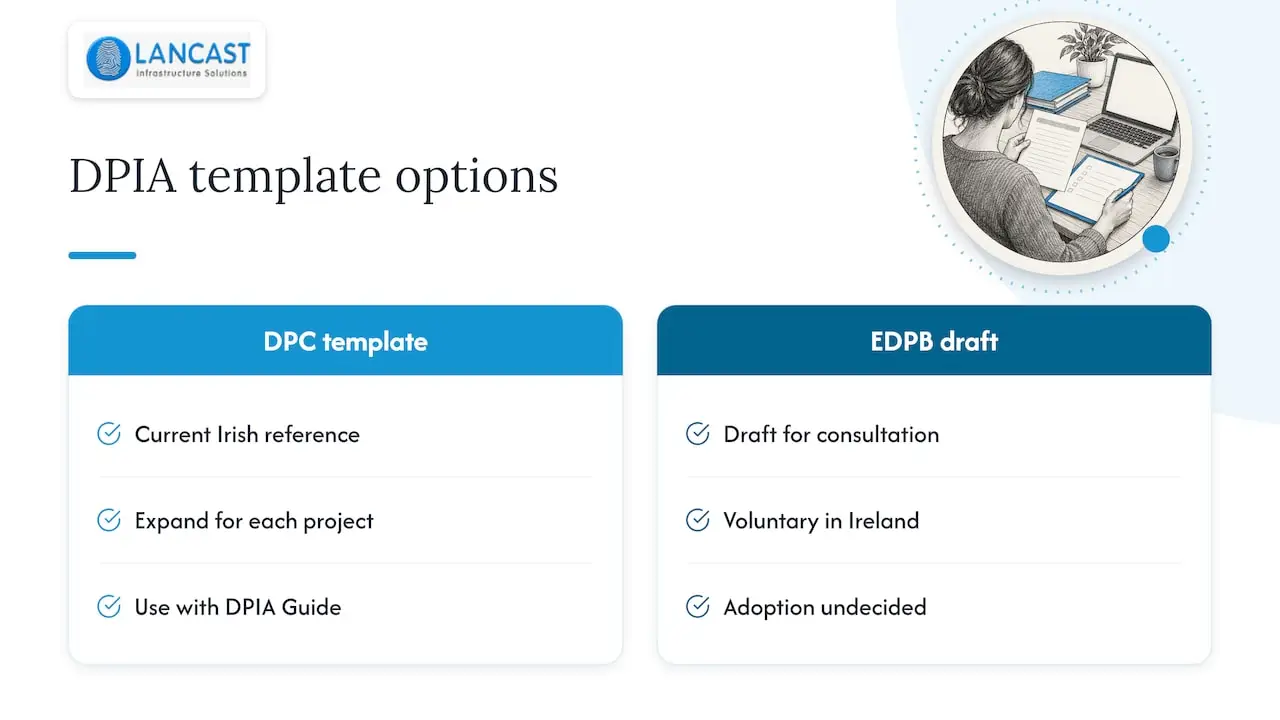
The DPC’s Sample DPIA Template is the natural starting point. It follows the seven steps above and the DPC says it is a guide that controllers should expand for each project, so a one-size-fits-all form is not the aim. Read it alongside the Guide to DPIAs.
In 2026 the EDPB published a draft common DPIA template for public consultation. Matheson reports that using it is voluntary and that Irish businesses can use it alongside the DPC’s 2019 guide to meet Article 35(7). Supervisory authorities will then decide whether to adopt it as their sole standard or as a model that national templates align with. For now, the DPC template remains the Irish reference, and checking the DPC’s guidance page for the latest version is worthwhile before you start. The DPC also notes that its guidance does not constitute legal advice.
Whichever template you use, a good DPIA is specific. Replace generic phrases with the names of systems, suppliers, locations and retention periods.
What to prepare before you start
Most of the time in a DPIA goes on finding facts, not on writing. Before you open the template, gather the following.
- A data map. What personal data is collected, from whom, and where it flows.
- A system and supplier list. Servers, laptops, cloud services, printers and copiers that store scans, and every processor with access.
- Access records. Who holds which permissions, and how they are reviewed.
- Security evidence. Patch status, vulnerability scan results, antivirus and endpoint protection, encryption settings, firewall rules.
- Recovery evidence. Backup schedules, where copies are held and the date of the last successful restore test.
- Policies. Retention, incident response, acceptable use and password rules.
If some of this does not exist, the DPIA will tell you. That is useful, not a failure, because the gaps become the measures in Step 6.
Promo: the technical side of your DPIA
We provide IT security and data protection services, including threat risk assessment and planning, vulnerability management, penetration testing and anti-virus management, as well as backup, data recovery and disaster recovery. Our Silver, Gold and Platinum Support plans cover proactive monitoring with remote and onsite support, so the controls you describe in a DPIA are maintained after the document is signed.

If you are planning a project that will need a DPIA, such as a Microsoft 365 migration or a new line-of-business system, get in touch with us while the design is still open. The legal assessment remains yours, and your DPO or legal adviser should confirm the lawful basis and the final sign-off. We can help you document how the technology protects the data.
Our perspective
In our experience as an IT infrastructure and managed services provider, we are proud to have supported Irish organisations for 30 years, and the pattern we meet is consistent. A DPIA is treated as a legal form to be filled in once, when it should be a working description of how data is protected in practice.
The strongest assessments we can imagine start from a clear picture of the environment: managed devices, monitored systems, controlled permissions, tested backups and a regular cycle of vulnerability checks. When those foundations are in place, the risk and measures steps of a DPIA become a matter of recording what is already true.
That is why we favour a proactive approach to IT. Continuous monitoring and early threat detection reduce the likelihood of an incident, and that likelihood is exactly what Step 5 asks you to rate. As a Microsoft Cloud Service Provider and HP Amplify Partner, we also help clients design cloud and hardware changes so that data protection is part of the build from the first day, which is what data protection by design means.
Our advice is simple: involve your IT partner at Step 2 rather than Step 6, and review the DPIA whenever the system changes.
Carl
FAQ
Is a DPIA mandatory for every Irish business?
No. A DPIA is required only where processing is likely to result in a high risk to individuals’ rights and freedoms. You should still assess and record the decision for each new processing operation, noting why a DPIA is or is not needed.
Is there an official Irish DPIA template?
Yes. The DPC publishes a Sample DPIA Template with seven steps, from identifying the need to sign-off. It is meant to be expanded for each project and read with the DPC’s Guide to DPIAs.
Who should be involved in a DPIA?
The project owner leads, with input from relevant colleagues, any processors and your technical or information security staff. Your DPO, if you have one, advises on compliance and whether processing can proceed. You should also consider consulting the people whose data is affected.
What if a high risk remains after my safeguards?
You must consult the Data Protection Commission in writing before you start the processing. The Commission has six weeks to issue written advice, extendable by up to a further month for complex processing, so plan your timeline around it.
Do I have to review a DPIA after it is signed?
Yes. The DPC template says the DPIA should be kept under review, and gov.ie advises reviewing after processing begins to check it still matches the assessment. Revisit it when systems, suppliers or purposes change.
Sources
- DPC: Data Protection Impact Assessments
- DPC: DPIA requirements, 15 November 2018
- DPC: Guide to Data Protection Impact Assessments, October 2019
- DPC: Sample DPIA Template
- Data Protection Act 2018, Section 84
- EDPB: Data protection guide for small business
- gov.ie: Rules and obligations regarding the processing of personal data
- Matheson: EDPB adopts common DPIA template
- University College Cork: Data Protection Impact Assessment Procedure
- Irish College of GPs: Processing of patient personal data, a guide for GPs
- Resyme: DPIAs and GDPR recruiting