
Device lifecycle management is the structured process of planning, deploying, maintaining, refreshing and retiring every endpoint an organisation owns, governed by clear policy, a single accurate inventory and verified disposal. The approach that works is stage-based and security-first: every laptop, desktop or peripheral moves through defined checkpoints rather than drifting until something breaks. Three levers decide whether a programme succeeds: policy thresholds that trigger action automatically, one inventory that every team trusts, and disposal that is verified, not assumed.
TL;DR:
- Keep one inventory source across ITAM, device management, and security tools; reconcile it daily or weekly against connected devices to expose shadow endpoints.
- Tie replacement triggers to warranty expiry, repair cost, or performance thresholds, and budget a year ahead instead of waiting for devices to fail.
- Require encryption and identity checks before deployment, then schedule updates and verify endpoint detection and response sensors are reporting.
- Erase retired devices to a verified standard, reuse them before recycling, and retain a certificate of erasure or destruction for every unit.
- Assign named owners for policy, procurement, security, and local handling, then audit inventory against physical devices quarterly and track patch coverage and disposal certificates.
Table of Contents
- What device lifecycle management covers and why it matters
- Standard lifecycle stages and the key deliverables at each stage
- A practical stage-aligned checklist IT teams can adopt now
- Governance, KPIs and role mapping to make DLM auditable and repeatable
- Tool categories and integration points: what to connect and why
- LANCAST practitioner perspective: how a managed service can deliver DLM outcomes
- Where to start in the next 90 days
- How LANCAST can help with assessment and managed device lifecycle services
- FAQ
- Sources
What device lifecycle management covers and why it matters
Device lifecycle management (DLM) spans more than laptops and desktops. It covers firmware, software entitlements, peripherals, printers and the growing population of IoT endpoints that connect to the corporate network. Each of these carries its own patch cadence, warranty terms and disposal requirements, and treating them as a single category is where most programmes lose control.
Done well, DLM delivers four concrete benefits:
- Cost control, because refresh and repair decisions follow data rather than guesswork.
- Lower security risk, since unpatched or unaccounted devices are a common entry point for attackers.
- Compliance support, with an auditable record of who held what device and when it was retired.
- Environmental gains, through reuse and certified recycling rather than default disposal.
DLM sits alongside IT asset management (ITAM), mobile device management (MDM) and security operations rather than replacing any of them. ITAM tracks ownership and value, MDM enforces configuration, and security operations monitors behaviour. DLM is the process that ties their outputs to a single timeline for each device, from purchase order to certificate of destruction. Our own practical guide to IT asset management for SMBs sets out how these disciplines fit together in more operational detail.
Standard lifecycle stages and the key deliverables at each stage
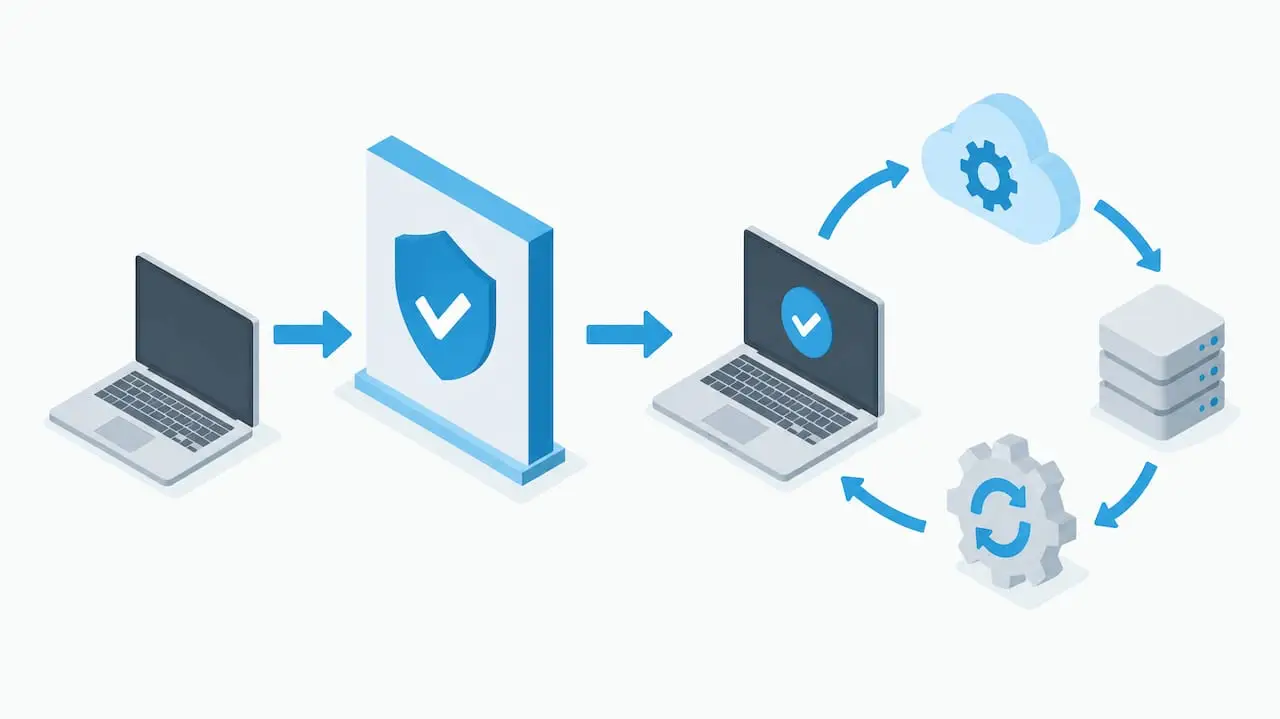
Most DLM frameworks converge on five stages, and the discipline is in defining what “done” looks like at each one rather than the stage names themselves.
- Plan and procure. Set hardware standards, require vendor support terms and documented end-of-life dates before a purchase order is raised. This is also where procurement planning decisions about repairability and standardisation pay off for years.
- Configure and deploy. Build a secure baseline image, enforce encryption and identity checks before first use, and record the device in the master inventory on day one.
- Operate and maintain. Run a defined patch and update cadence, monitor endpoint detection and response (EDR) health, and reconcile inventory against what is actually connected.
- Refresh and replace. Set objective triggers, age, warranty expiry, repair cost or performance thresholds, that prompt replacement rather than waiting for failure.
- Decommission and dispose. Erase data to a verified standard, then route the device up the waste hierarchy: reuse first, recycle second, disposal only as a last resort, as WRAP’s waste hierarchy guidance sets out.
Security and sustainability controls belong inside each stage rather than bolted on afterwards. The ENISA Secure By Design and Default Playbook is explicit that secure-by-design principles need to be operationalised across the full product life cycle, including maintenance and controlled disposal with proper data erasure mechanisms, not treated as a one-off checklist at purchase.
A practical stage-aligned checklist IT teams can adopt now
A programme becomes repeatable once each stage has a short, specific checklist that any team member can follow without interpretation.
- Procurement: standardise on a small number of SKUs, require published vendor support terms and end-of-life dates, and favour repairable, energy-efficient devices over the cheapest unit cost.
- Deployment: use automated imaging, apply a secure-by-default configuration, and make identity verification and full-disk encryption mandatory before a device leaves onboarding. Our guide on deploying endpoint encryption safely covers the practical steps.
- Operations: reconcile inventory daily or weekly against what is actually online, run patch windows on a fixed schedule, and check EDR sensor health rather than assuming agents are reporting correctly.
- Refresh: define trigger rules in advance (age, warranty, repair cost), budget for replacement a year ahead, and script the data migration path so nothing is left on a retired device.
- Disposal: require certified data erasure, follow the reuse-then-recycle hierarchy, and keep a documented certificate of destruction for every unit.
Pro Tip: Tie your refresh trigger to warranty expiry rather than calendar age alone, repair costs rise sharply once a device is out of manufacturer support.
ENISA’s playbook reinforces two of these points directly: automated maintenance and updates, and mandatory security onboarding, are named as lifecycle controls rather than optional extras.
Governance, KPIs and role mapping to make DLM auditable and repeatable
A DLM programme survives audits and leadership turnover only when it has named owners and measurable outcomes rather than informal habits.
- Inventory accuracy: the percentage of devices in the system of record that match what is physically deployed.
- Patched device coverage: the share of the fleet running a supported, current operating system.
- Mean time to patch: how long it takes a critical update to reach every eligible device.
- Verified disposal completion: the proportion of retired devices with a documented erasure or destruction certificate.
Ownership typically splits four ways: a central IT owner accountable for the overall policy, a procurement lead who enforces standards at purchase, a security owner who signs off on patch and disposal controls, and local custodians who manage day-to-day handling in each site or department. Policy should spell out retirement thresholds in writing, define how exceptions get approved, and set a fixed cadence, quarterly is common, for auditing the inventory against reality.
Tool categories and integration points: what to connect and why
The tooling question matters less than the integration between tools. Five categories cover most needs: ITAM or a configuration management database (CMDB), MDM or endpoint management, EDR, patch management, and the procurement system that raises purchase orders in the first place.
- Keep one inventory source that every other tool writes to, rather than letting ITAM and MDM maintain separate lists that drift apart.
- Automate event tagging, so a repair, a refresh or a transfer updates the record without manual entry.
- Link security telemetry to asset records, so an EDR alert on a device can be traced instantly to its owner, location and warranty status.
When rolling out or consolidating tools, set vendor-agnostic criteria first, integrate in phases rather than all at once, and audit for duplicate inventories before adding anything new, they are the single most common source of inaccurate reporting.
LANCAST practitioner perspective: how a managed service can deliver DLM outcomes
Many IT teams outsource the parts of DLM that are repetitive but high-stakes: procurement coordination, imaging and deployment, ongoing monitoring, and certified disposal. As an HP Amplify Partner and Microsoft Cloud Service Provider, we bring vendor relationships and monitoring infrastructure to these tasks directly. When evaluating a managed-service partner, ask for their patch cadence, their disposal certification process and how asset records link to security alerts before signing anything.
Where to start in the next 90 days
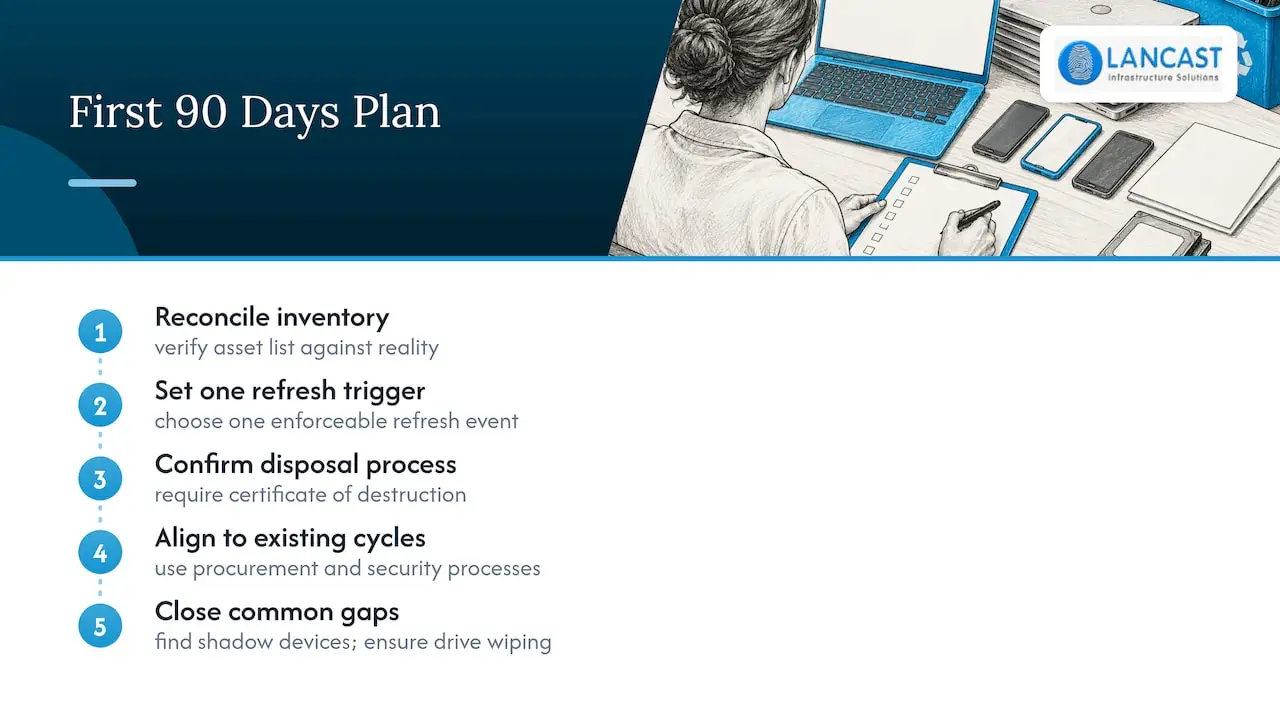
Start with the inventory, not the policy document: you cannot govern what you cannot see, and most programmes stall because the asset list is already wrong before anyone writes a retirement rule. In the first 90 days, reconcile your inventory against reality, set one refresh trigger you will actually enforce, and confirm your disposal process produces a certificate, not just a pickup.
The two pitfalls I see most often are inventory gaps that hide shadow devices, and disposal handled as an afterthought that leaves unwiped drives in the hands of a recycler. Align both to your existing procurement cycle and security roadmap rather than running DLM as a separate project, it only sticks when it rides on processes you already have.
— Carl
How LANCAST can help with assessment and managed device lifecycle services
We run DLM as a continuous service rather than a one-off project: procurement coordination, secure deployment, ongoing monitoring and certified disposal, delivered under a single support agreement. We build on vendor relationships and monitoring tools we already operate day to day, including the EDR sensor health benchmarks referenced above.

If your inventory, patching or disposal process has gaps you cannot fully account for, our managed services team can run a discovery assessment and show you exactly where the risk sits before it becomes a problem.
FAQ
What is device lifecycle management?
Device lifecycle management is the structured process of planning, deploying, maintaining, refreshing and retiring an organisation’s devices under a single policy and inventory. It covers hardware, firmware and software entitlements from the point of purchase through to certified disposal.
What are the 5 main stages of the device lifecycle?
The five commonly used stages are plan and procure, configure and deploy, operate and maintain, refresh and replace, and decommission and dispose. Each stage has its own deliverables, from procurement standards at the start to verified data erasure at the end.
Should device management be turned on?
Yes: enforcing device management controls such as encryption, identity checks and automated updates is a core part of secure-by-default practice recommended by ENISA’s Secure By Design and Default Playbook. Leaving it off removes visibility and control precisely where most security incidents originate.
What are the main types of device management?
The main types are mobile device management (MDM) for configuration and policy enforcement, endpoint detection and response (EDR) for security monitoring, and IT asset management (ITAM) or a CMDB for ownership and inventory tracking. Most organisations need all three connected to a single inventory rather than relying on just one.
What should happen to a device at the end of its life?
A retired device should have its data erased to a verified standard and then move up the waste hierarchy: reuse first, recycling second, with disposal to general waste only as a last resort, as WRAP’s guidance sets out. A documented certificate of destruction or erasure should be kept for every unit.