

IT asset management (ITAM) is the disciplined practice of tracking, managing, and optimising every hardware, software, and cloud resource throughout its entire lifecycle. For IT managers in County Wicklow’s small and medium-sized businesses, ITAM is as much a financial discipline as a technical one. Without it, organisations face compliance risk, budget waste, and the kind of operational blind spots that slow down incident resolution and procurement decisions. The ITIL framework defines ITAM as a core service management practice, and that framing matters: it positions asset visibility not as a one-off audit task, but as a continuous, integrated process that underpins everything from vendor negotiations to employee offboarding.
What are the core components of IT asset management?
IT asset management covers four distinct categories, each with its own tracking requirements and lifecycle considerations.
Hardware asset management focuses on the physical inventory: laptops, servers, printers, network switches, and peripherals. The goal is to know what you own, where it is, who has it, and when it needs replacing. Without a current hardware inventory, refresh planning becomes guesswork and hardware lifecycle management suffers.

Software asset management (SAM) governs licence ownership, deployment counts, and renewal dates. SAM prevents both under-licensing (a compliance risk) and over-licensing (a direct cost). Many SMBs discover, during their first proper SAM audit, that they are paying for software seats that have not been used in months.
Cloud and SaaS asset management is the fastest-growing challenge. SaaS subscriptions are easy to spin up and easy to forget. Without a centralised register, IT managers lose visibility over spend, data residency, and access rights when staff leave.
Configuration and dependency management sits beneath all three categories. It maps how assets relate to each other: which server supports which application, which switch connects which floor. That context is what turns a static inventory into a tool for faster incident resolution and confident change planning.
| Asset category | Primary management focus | Key lifecycle risk |
|---|---|---|
| Hardware | Inventory, location, refresh cycles | Lost or unrecovered devices |
| Software | Licence counts, renewals, compliance | Over or under-licensing |
| Cloud and SaaS | Subscription visibility, access control | Orphaned accounts, cost creep |
| Configuration | Dependency mapping, change context | Blind-spot incidents |
How does automation improve IT asset management efficiency?
Automated asset discovery is the single biggest efficiency gain available to SMBs. Manual spreadsheet inventories become obsolete within 3–6 months in growing organisations. That rate of decay makes manual tracking unsustainable for any business growing at more than 10–15% annually.
Automation solves this by continuously scanning the network, updating asset records in real time, and flagging discrepancies without human intervention. The practical result is significant: software provisioning time drops from up to four hours to a matter of minutes when ITAM is unified and automated. That is not a marginal gain. It directly reduces the time IT staff spend on routine tasks and frees capacity for higher-value work.
Integration with HR and procurement systems multiplies that benefit. When a new employee joins, an integrated ITAM platform can trigger device ordering, software provisioning, and access rights automatically. When someone leaves, the same integration flags devices for recovery and revokes licences. Platforms that support broad integration ecosystems make this kind of automated device lifecycle management achievable even for lean IT teams.
AI and machine learning add another layer by identifying patterns in asset data: flagging devices approaching end of life, predicting licence shortfalls, and surfacing anomalies that manual review would miss. Accurate, up-to-date asset records are the foundation that AI-driven workflows depend on. Without clean data, automation amplifies errors rather than eliminating them.
Pro Tip: Before deploying any automation tool, establish a verified baseline inventory. Automating on top of inaccurate data does not fix the data. It embeds the errors into every downstream workflow.
What challenges do SMBs face in IT asset lifecycle management?
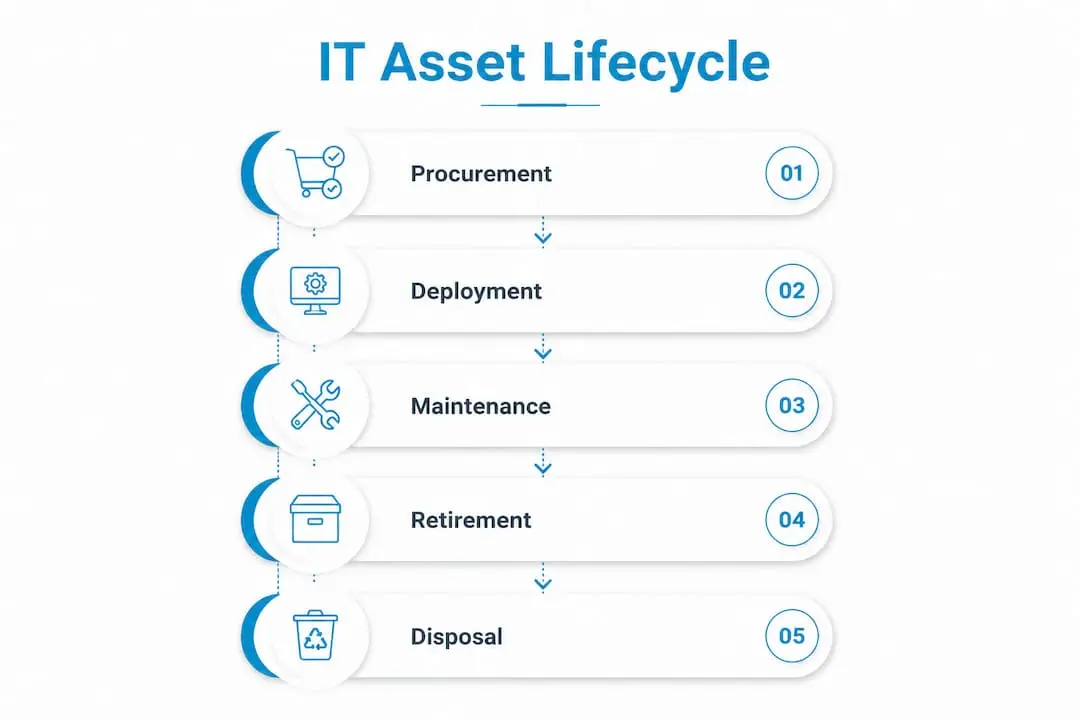
The asset lifecycle has five stages: procurement, deployment, maintenance, retirement, and disposal. Visibility gaps appear most often at the edges: when assets first arrive and when they leave the organisation.
Shadow IT is the most pervasive challenge. Unmanaged software and cloud services can represent 20–30% of software spend. That figure reflects the reality that employees adopt tools to solve problems, not to create compliance headaches. The answer is not to block everything. Policy-driven discovery, combined with a clear approval process, reduces shadow IT spend while maintaining productivity.
Device recovery at offboarding is where SMBs lose the most money in hardware terms. Poor recovery processes cost organisations 10–20% of device budgets annually. Remote and hybrid working has made this worse. A device that is not recovered is a device that must be replaced, and it may still hold sensitive data.
Stale asset data is the third major challenge. An inventory that was accurate six months ago is not accurate today. New devices arrive, old ones are retired informally, and software gets installed outside the approved process. Treating ITAM as a continuous service process rather than a periodic audit is the only sustainable fix.
Pro Tip: Establish a single source of truth for asset data before you connect any integrations or automation tools. Connecting multiple systems to a flawed master record does not resolve the inaccuracy. It spreads it.
How does effective ITAM support cost control and compliance?
ITAM is a direct cost control mechanism. Eliminating redundant licences and reclaiming idle assets reduces software spend without reducing capability. Organisations that run a proper licence reconciliation for the first time routinely find seats that have not been used in months, subscriptions that duplicated existing tools, and maintenance contracts on hardware that was retired years ago.
The compliance benefits are equally concrete. ITAM provides the documentation trail that auditors require: when an asset was purchased, who used it, how data was disposed of at end of life, and whether licences were within agreed terms. Without that trail, audit readiness becomes a reactive scramble rather than a routine confirmation.
Vendor negotiation is a less obvious benefit, but a real one. When you know exactly how many licences you use, when renewals fall due, and what your consumption trends look like, you negotiate from a position of knowledge rather than assumption. Vendors price contracts on the assumption that buyers have incomplete data. Accurate ITAM removes that asymmetry.
The financial and compliance benefits of effective ITAM include:
- Reduced software spend through licence reclamation and deduplication
- Lower hardware costs through planned refresh cycles rather than emergency replacements
- Audit readiness without last-minute data gathering
- Documented data disposal records for GDPR compliance
- Stronger vendor negotiation through accurate consumption data
- Reduced security exposure from untracked or unpatched assets
What practical steps can IT managers take to implement ITAM?
A structured implementation does not require a large budget or a dedicated ITAM team. It requires a clear sequence.
Step 1: Run an asset discovery. Use a network scanning tool to build a baseline inventory of every connected device and installed application. Do not rely on existing spreadsheets as your starting point. Verify first.
Step 2: Classify and categorise. Group assets by type, owner, location, and lifecycle stage. This classification is what makes the inventory useful rather than just comprehensive.
Step 3: Integrate with your service desk and HR systems. Asset data that sits in isolation becomes stale. Connecting it to your IT service management platform means every ticket is automatically associated with the relevant asset. Connecting it to HR means joiners and leavers trigger asset workflows automatically.
Step 4: Build lifecycle processes. Document what happens at each stage: who approves procurement, who configures new devices, what the offboarding checklist includes, and how disposal is recorded. Lancast’s hardware and software services support this kind of structured lifecycle management for SMBs that need external expertise.
Step 5: Schedule regular reconciliation. Quarterly reconciliation between your asset register and your actual inventory catches drift before it becomes a compliance problem. Monthly is better for fast-growing teams.
Step 6: Select tools with the integrations you need. The right platform depends on your existing stack. Prioritise integration with your service desk, HR system, and procurement process over feature count.
Pro Tip: Do not try to manage everything at once. Start with hardware, get that accurate, then layer in software asset management. Trying to tackle all asset categories simultaneously is the most common reason ITAM projects stall.
Key takeaways
Effective IT asset management requires accurate data, continuous processes, and integration with HR and service desk systems to deliver real cost and compliance benefits.
| Point | Details |
|---|---|
| Start with a verified baseline | Run asset discovery before connecting any automation or integration tools. |
| Integrate with HR and service desk | Automate joiner and leaver workflows to prevent licence waste and device loss. |
| Treat ITAM as a continuous service | Quarterly or monthly reconciliation prevents stale data from undermining compliance. |
| Shadow IT needs policy, not just blocks | Discovery-led controls reduce unmanaged spend while maintaining staff productivity. |
| ITAM is a financial discipline | Licence reclamation and vendor negotiation deliver measurable cost savings. |
Why reactive ITAM is the most expensive approach
I have worked with enough SMBs to say this plainly: the organisations that treat ITAM as a once-a-year audit exercise always pay more than the ones that treat it as an ongoing service. Not slightly more. Significantly more, in wasted licences, unrecovered devices, and emergency hardware replacements that could have been planned.
The cultural shift is harder than the technical one. Getting procurement, HR, and IT to share data and coordinate processes takes more effort than deploying a discovery tool. But that coordination is where the real value lives. A tool without a process is just another system generating data that nobody acts on.
The emerging role of AI in ITAM makes accurate data even more critical. Intelligent workflows depend on asset records that reflect reality. If your inventory is six months out of date, your AI-assisted service desk is making decisions based on a fiction. The organisations that will benefit most from AI-driven IT operations are the ones that have already done the unglamorous work of getting their asset data right.
My honest advice to any IT manager in County Wicklow starting this process: do not wait for the perfect tool. Start with what you have, get your baseline accurate, and build the integrations one at a time. The discipline matters more than the platform.
— Carl
How Lancast supports SMBs with IT infrastructure and asset management
Lancast has been supporting IT infrastructure across Ireland for over 30 years, working with businesses that need reliable, proactive management of their hardware and software environments.
For SMBs in County Wicklow looking to bring structure to their asset lifecycle, Lancast offers managed IT services that cover hardware maintenance, software support, and proactive monitoring. Our IT solutions and services are built around the specific needs of small and medium-sized businesses, with the depth of expertise to support everything from initial asset discovery through to end-of-life disposal. If you are ready to bring clarity and control to your IT environment, get in touch with the Lancast team.
FAQ
What is IT asset management?
IT asset management (ITAM) is the process of tracking and managing all hardware, software, and cloud assets throughout their lifecycle, from procurement to disposal. It supports cost control, compliance, and operational efficiency.
What is the difference between hardware and software asset management?
Hardware asset management tracks physical devices including their location, condition, and refresh schedule. Software asset management governs licence ownership, deployment counts, and renewal dates to maintain compliance and control spend.
How does shadow IT affect IT asset management?
Shadow IT can represent 20–30% of software spend in organisations without active discovery and policy controls. Managing it requires a discovery phase followed by a clear approval process, not blanket technical blocks.
Why do SMBs lose money on device recovery?
Poor offboarding processes mean devices are not returned when employees leave, costing organisations 10–20% of device budgets annually. Treating device recovery as a formal step in the offboarding checklist directly reduces this loss.
How often should IT asset inventories be reconciled?
Quarterly reconciliation is the minimum for most SMBs, with monthly cycles recommended for teams growing quickly or managing a high volume of remote devices. Manual inventories become unreliable within 3–6 months without automated updates.